Rent collection is a solved problem. Buildium, AppFolio, DoorLoop, and TenantCloud all handle ledgers, online payments, owner statements, and 1099s competently, and if you manage property you almost certainly already run one of them.
What those products handle less completely, particularly on their lower tiers, is everything that happens between rent payments. Maintenance requests arriving by phone and text. Vendors who quoted but never scheduled. Lease renewals that needed a conversation two months ago. Inspection photos sitting in someone's camera roll.
That work usually ends up in a spreadsheet and a shared mailbox. This page is about moving it somewhere structured, without touching the accounting system that already works.
What sits outside the accounting product
The gap is consistent across portfolios.
Maintenance intake. A tenant calls, texts, or emails. Someone writes it down. Whether that becomes a tracked item depends on how busy the day was.
Vendor coordination. Requested, quoted, approved, scheduled, completed, invoiced. Six states with external dependencies at four of them. Most accounting products model a work order but not the negotiation around it.
Approval thresholds. A $300 repair is routine and a $3,000 repair needs owner sign-off. That approval happens in email and its absence is discovered at invoicing.
Lease renewals and expiries. A date that matters, needing action sixty to ninety days ahead. Reports exist in most products but nothing arrives to tell you.
Inspections. Move-in, move-out, periodic. Photos, notes, and a comparison against last time.
Each is a record with a status, an owner, and a date. Structured data, not accounting.
The maintenance request path
This is the build most property teams start with, and it is worth doing before anything else because it removes the phone-and-sticky-note problem immediately.
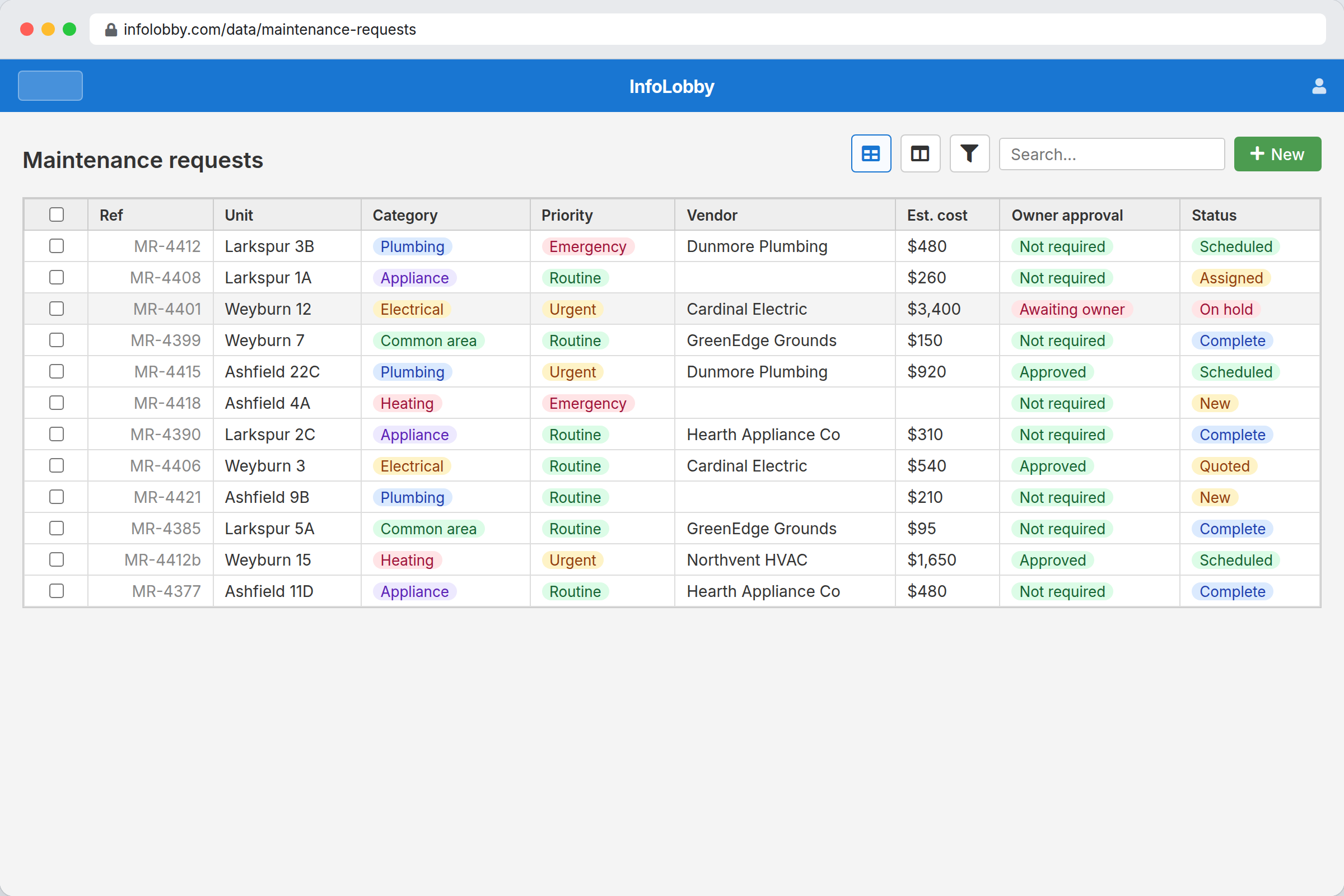
A public web form gives tenants a place to submit. No account, no app, no login. The form creates a request record directly:
| Field | Type | Purpose |
|---|---|---|
| Unit | Connection | Links to the Units table |
| Tenant | Connection or Text | Who reported it |
| Category | Category | Plumbing, electrical, appliance, common area |
| Priority | Category | Emergency, urgent, routine |
| Description | Long text | What they said |
| Photos | File | What they saw |
| Status | Category | New, assigned, quoted, approved, scheduled, complete |
| Vendor | Connection | Who is doing it |
| Estimated cost | Number | Drives the approval rule |
| Owner approval | Yes/No | Set when required |
Then two automations do most of the useful work. When estimated cost exceeds your threshold, notify the owner and hold the request in an approval state. When a request has been in New or Assigned for more than a set number of days, notify the property manager.
Emergency requests are worth a separate rule that notifies immediately on submission rather than waiting for someone to check a queue.
Form counts matter for portfolios. Starter includes 2 web forms, Team 10, Business unlimited. Running a separate branded form per property means Team at $59 per month, or Business at $129 if the portfolio is large.
Units, leases, and dates that need warning
Units and leases as separate tables is the structure that pays off later.
Units is the physical thing: property, unit number, bedrooms, square footage, appliances, and the notes that persist across tenancies.
Leases connects a unit to a tenant with a start date, an end date, a rent amount, and a deposit. One record per tenancy, so the unit accumulates history rather than overwriting it.
That separation makes two questions answerable that a single spreadsheet cannot handle: what has happened to this unit over five years and three tenants, and which leases expire in the next ninety days.
The renewal automation is the same shape as everything else here. Ninety days before a lease end date, notify the property manager. Sixty days before, notify again if the status has not changed.
What the accounting products cost
Figures below were read from each vendor's own pricing page on 2026-08-20. Property management pricing commonly scales by unit count and several products enforce minimums.
| Product | Model | Published rates |
|---|---|---|
| AppFolio | Quote only, per unit | No public rates. Core carries a 50-unit minimum; Plus and Max add minimum spend |
| Buildium | Tiered | Essential from $62/mo, Growth from $192, Premium from $400 |
| DoorLoop | Tiered, unit-capped | Starter $99/mo ($69 annual), max 10 units. Pro $189 ($149), Premium $239 ($209). About $3/unit above 10 |
| TenantCloud | Tiered, unlimited units | Starter $18/mo ($15 annual), Growth $35 ($29), Pro $60 ($50) |
| InfoLobby | Flat, unlimited users | $29 / $59 / $129 |
InfoLobby is not an alternative to any of these, and the table is here for scale rather than substitution. You will still pay for one of them. The question is whether the maintenance and vendor side is already handled well enough by the one you have.
Worth noting against our own interest: TenantCloud Starter at $18 a month covers unlimited units and includes maintenance management. A small portfolio that fits inside it has little reason to add a second system.
When you should not add this
Be genuinely skeptical here, because this is an additional subscription on top of one you already pay.
Your accounting product already handles maintenance well. Buildium and AppFolio both have work order modules. If yours is in use and working, adding a second system splits your data for no gain. The teams who benefit are the ones whose maintenance is demonstrably outside their main product, usually because they are on an entry tier or because the workflow does not fit.
You manage under about twenty units. At that scale the spreadsheet and the mailbox are genuinely adequate, and the overhead of a second system is not repaid.
You want rent, ledgers, or owner statements here. There is no payment processing, no tenant ledger, no accounting, no 1099 generation, and no listing syndication. This is not a property management system and will not become one.
Maintenance requests are the entire problem. If units and leases are already fine and only the request queue hurts, read the work order software use case instead. It covers that setup directly and more simply than this page does.
The realistic fit is a manager with somewhere between fifty and several hundred units, running an accounting product for the money, whose maintenance and vendor coordination has outgrown a spreadsheet but does not justify moving to a higher accounting tier.
Sources checked
- InfoLobby plan limits, pricing, and web form counts: current pricing page, checked 2026-08-20
- Buildium pricing, checked 2026-08-20. Figures are "starting at" rates
- DoorLoop pricing, checked 2026-08-20. Annual rates in brackets; a promotional discount was running at the time
- TenantCloud pricing, checked 2026-08-20
- AppFolio pricing: quote-only at the time of checking. Unit minimums are stated but rates are not published
- Pricing in this category changes frequently and often varies by portfolio size. Confirm with the vendor before deciding
InfoLobby plan pricing and limits, and the competitor claims on this page, were last checked on 2026-08-20. Competitor pricing changes often and varies by region, so confirm current figures on the vendor's own pricing page before deciding. Our plans are on the pricing page.